
Building Belonging: How UPlift Black and Hope for Refugees International Support Queer Newcomers in Canada


For BIPOC, Queer refugees and newcomers arriving in Canada, safety does not automatically come with status. Even when services exist, many remain out of reach, shaped by systems that assume fluency in English or French, confidence navigating complex legal systems, red tape, and relevant comfort in predominantly white or heteronormative spaces.
The experiences of 2SLGBTQ+ refugees are nuanced, often complex, with many people fleeing one of the 64 countries worldwide criminalizing same-sex relations, where Queer people face threats ranging from imprisonment to death. And every year, thousands of people are escaping this persecution. Rainbow Railroad, a North American organization helping Queer people relocate to safety, reports receiving more than 50 requests for help every day in 2025.
Yet, upon arrival, many newcomers encounter discrimination even within diaspora communities in Canada. A 2024 report from The Enchanté Network shows that 86% of Black 2SLGBTQI+ people in the country have encountered anti-Black racism in 2SLGBTQI+ spaces, while 53% have faced the threat of a hate crime or an incident based on their sexual orientation or gender identity.
Navigating settlement systems to access housing, healthcare, employment, and immigration can be especially daunting when programming is not designed with cultural or linguistic accessibility in mind. These intersecting experiences mean that belonging is not simply a matter of legal status but a process requiring intentional, culturally responsive support to affirm both racialized and Queer identities while providing practical pathways to stability and community. This is where culturally sensitive, trauma-informed programming becomes crucial.
One example is UPlift Black’s You Belong Here Program. Randy Singh, director of the program, says he didn’t find UPlift, it found him. Getting his hair done across the street from our former office, the barber let him know that across the street, there was a place for people like us: Queer, BIPOC, creative, and driven by change.
UPlift Black: You Belong Here
UPlift Black disrupts exclusionary systems by creating spaces where Black Queer people are not only supported, but affirmed. This commitment is the foundation of the You Belong Here newcomer program. At its core is the belief that belonging must be built intentionally, with programming designed with the community, led by people who share lived experience as queer, BIPOC newcomers, and grounded in the understanding that healing and survival are collective processes.
What makes the services provided by UPlift Black especially powerful is its commitment to full-circle care. Many of the people leading programs once arrived as refugees themselves, relying on community services in their journey to find belonging. Today, members like Randy Singh and Liz Nabbosa are the ones welcoming newcomers at the door, translating systems, and reminding people that they are not alone. Read an interview with Liz and Randy in Queer & Now, a 2SLGBTQ+ column published by Now Magazine.
This continuity of care transforms survival into leadership and trauma into collective strength. But this work does not exist in a silo, and is always more effective when done in collaboration with other organizations rooted in similar values, such as Hope for Refugees International.
Hope for Refugees International
When Patrick King Mwesigye arrived from Uganda in 2022, he didn’t foresee his own survival story would become the foundation for a lifeline he would go on to create for others. After being outed as Queer in what he describes as a deeply homophobic political and social climate, Mwesigye left behind a career, family, and friends, coming to Toronto as a refugee.
Landing in Toronto, his experience included staying in shelters, experiencing intense isolation, racism, and continued homophobia within the diaspora space. This, he says, revealed a painful truth: arrival does not equal belonging.
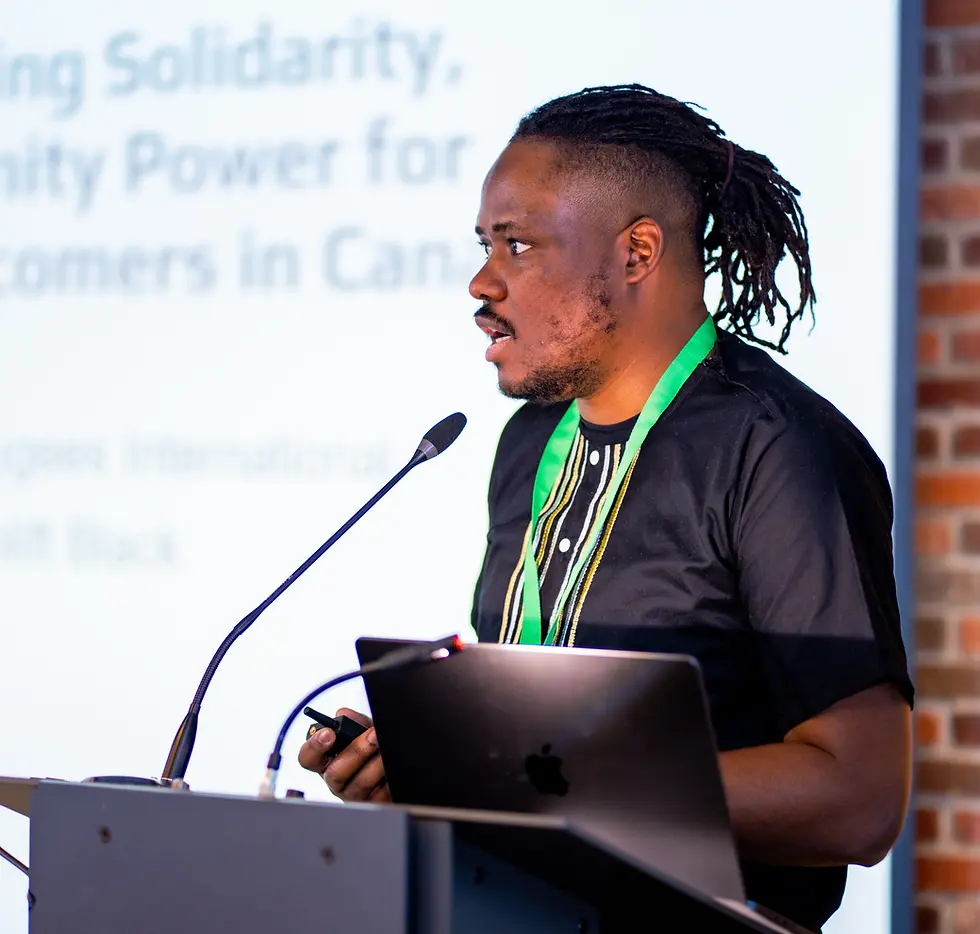
Out of this experience, Hope for Refugees International was born. The refugee-led, grassroots organization supports refugees and newcomers of African descent, many of whom are Black and LGBTQ, through culturally responsive, trauma-informed settlement support. The organization exists to bridge the gap between formal services and the lived realities of newcomers, who have to learn to navigate housing, healthcare, employment, and immigration systems for the first time, often while coping with deep trauma and isolation.
Access is Everything
Mwesigye’s vision is rooted in lived experience. After surviving homelessness and a breach of confidentiality in a shelter, he realized how easily Queer refugees fall through the cracks, even in systems designed to help. Information was difficult to access, services were often linguistically or culturally inaccessible, and many newcomers were unsure who to trust.
“The barriers were still there,” Mwesigye explained. “They did not understand us and who we are as newcomers, also as Black folks.”
The founder also explained that creating a service does not guarantee that the people it is designed for are going to use it.
“You might have a door that is open on the eighth floor, but the elevator is not working. You say ‘use the stairs,’ but not everyone is in a position to use the stairs, even if there is a service on the eighth floor.”
This example of physical access is mirrored in the ways that many refugee or newcomer services are not accessible for many BIPOC and/or 2SLGBTQ+ people.
“So if your services are not culturally appropriate and comprehensive, and they do not understand the needs of folks you're serving, and you're not making your space safe and like home for the people accessing them, then they’re not effective.”
The organization began with almost no resources, running on virtual Zoom sessions limited to forty minutes, with all operations funded out of Mwesigye’s pocket. But it quickly grew into a trusted hub for support, helping newcomers apply for permanent residency, secure housing, find employment, and navigate school systems for their children.

Mwesigye says that the work is often as simple as it is vital, and includes tasks like writing letters to landlords, serving as job references, or translating information into formats people can actually use. And this kind of work makes all the difference.
“Even when an organization is accessible, the question is: is it safe? Are the people accepting of you?” Singh explained. “Those doubts alone can stop someone from getting the resources they need.”
“But when we come into spaces where we belong, then it's easy to open up,” Mwesigye shared.
“Once people feel welcome,” Singh says, “everything else falls into place.”
UPlift Black X Hope for Refugees International
Hope for Refugees International partners closely with UPlift Black, where Singh and Mwesigye work together to develop and provide wrap-around, culturally sensitive support services. Their approach is grounded in a simple but powerful principle: Change must be built with the people who need it. As such, programs are led by people who reflect the communities they serve, ensuring safety, dignity, and trust.
For many participants, the impact of this programming is deeply personal. Mouths are fed, paperwork is filed, and families move out of shelters and into stable housing. Jobs are secured, and parents are supported through enrolling their children in school. Perhaps most importantly, people find community in their new found home, sometimes for the first time.
Singh, who arrived in Canada as a refugee from Guyana in 2013, says that community organizations once sustained him through loneliness and uncertainty. Today, he offers that same support to others, helping newcomers feel safe, seen, and valued: a true full circle moment.
“All the organizations that helped ground me as a refugee, I now get to do that work for others.”
Together, UPlift Black and Hope for Refugees International are more than service providers; they are support systems. In a world where support often depends on language, mobility, or confidence, we insist on meeting people where they are. Through empathy, cultural understanding, and shared experience, we are able to offer something many newcomers are denied: not just help, but hope.


Comments