
$11.71 for Prisons, $1.00 for Community: Why I’m Taking Simcoe County’s Reality to the Senate of Canada

I have received an official invitation to appear in person as a witness before the Standing Senate Committee on Human Rights, known as RIDR, on Monday, November 30, 2026, as part of its formal study on Canada’s Black Justice Strategy.
I will be there as the President and Founder of UPlift Black. I will be there carrying the voices of Barrie, Simcoe County, and the many Black families, youth, newcomers, artists, entrepreneurs, elders, and neighbours who know that justice is not built in Ottawa alone.
Justice is built in the places where people live.
It is built in the youth room that stays open after school. It is built at the food table. It is built through court navigation, mentorship, newcomer support, healing spaces, business guidance, and a consistent community presence. It is built when an organization can keep its doors open long enough for trust to form.
That is why I am going to the Senate with a clear message: Canada cannot call this a Black Justice Strategy if the funding does not reach Black communities outside the usual big-city corridors.

The federal incarceration bill is already in public view
When people talk about justice spending, they often talk about programs, grants, pilots, and strategies. I want to start with what Canada is already paying for every year.
Black Canadians make up about 3.5% to 4% of the adult population, yet represent 9.2% of federal prisoners.
That gap is not abstract. It has a budget line attached to it.
Out of Canada’s roughly $3.8 billion annual federal corrections budget, Ottawa spends about $349.6 million every year incarcerating Black people.
The cost of federal custody is staggering:
$150,505 per year
The estimated annual cost to incarcerate one man in federal custody.
$259,654 per year
The estimated annual cost to incarcerate one woman in federal custody.
More than $207 million per year
The estimated excess annual cost tied to Black overrepresentation in federal prisons.
This is the part that should stop every policymaker in their tracks: 85.8% of Black offenders do not return to custody within five years.
Yet systemic bias at intake continues to disproportionately label Black people as “high risk.” That label follows people through custody, programming access, release planning, parole decisions, and reintegration.
So Canada is spending hundreds of millions each year to lock Black people up, while the evidence shows that the overwhelming majority do not return to custody within five years.
That should force a serious national question.
If the goal is safety, why is the largest and most reliable investment still incarceration?
What the $412.7 million headline hides
On paper, the federal government has announced major funding for Canada’s Black Justice Strategy.
Across the 2024 Fall Economic Statement and Budget 2026, Ottawa announced $412.7 million over six funded years for the 10-year Black Justice Strategy.
That includes:
$276.4 million
Announced in the 2024 Fall Economic Statement.
$136.3 million
Announced in Budget 2026.
About $68.8 million per year
The average annual amount over the six funded years.
Four years still unfunded
The strategy is described as a 10-year plan, but only six years are funded.
The headline sounds large. The reality is much smaller for community-led justice work.
Nearly half of the total funding, $189 million, or 45.8%, is actually the Black Entrepreneurship Program. Much of that is tied to debt-based commercial loans and big-city incubator models.
Let me be clear. Black entrepreneurship matters. Business ownership, creative enterprise, and economic mobility are part of justice. At UPlift Black, we support business mentorship, artist incubation, and investment-readiness pathways because economic exclusion is connected to justice outcomes.
But a debt-based loan fund is not the same as community-led prevention. It is not the same as youth diversion. It is not the same as legal navigation. It is not the same as reintegration support. It is not core funding for a regional Black hub keeping its doors open every day.
Another approximately $44.7 million, or 10.8%, stays inside federal agencies such as:
The RCMP
Correctional Service Canada
Statistics Canada
Again, data and institutional work have a role. But when funding counted under a Black Justice Strategy remains inside policing, prisons, and federal bureaucracy, the public deserves a clear breakdown.
Communities should not have to decode budget announcements to find out how much money actually reaches them.
The 11.7 to 1 ratio tells the real story
After the Black Entrepreneurship Program and internal federal agency allocations are removed, only about $179.1 million over six years is left for community-led prevention, youth diversion, legal navigation, and reintegration nationwide.
That works out to about $29.85 million per year for the entire country.
Now compare that to federal incarceration spending.
Ottawa spends $11.71 locking Black people up for every $1.00 invested in community prevention.
The entire national community prevention budget, about $29.85 million per year, equals the cost of holding just 198 men or 115 women in federal prison for one year.
That is the ratio I will bring to the Senate table.
Not because numbers alone tell the whole story. They do not. Behind every number is a person, a family, a community, and a path that could have gone differently if support had arrived earlier.
But numbers do expose priorities.
A country that can pay hundreds of millions each year for incarceration can also fund the community infrastructure that prevents harm, supports accountability, and helps people come home safely.
Community prevention is not charity. It is public safety work. It is economic development work. It is mental health work. It is youth work. It is newcomer support. It is food security. It is housing navigation. It is the patient, daily labour of keeping people connected before crisis becomes custody.

Simcoe County cannot be shut out of Black justice funding
Here is what I will say plainly: not a single dollar of the $189 million Black Entrepreneurship Program has reached Simcoe County.
That matters.
Barrie and Simcoe County are not side notes in Canada’s Black future. Black people live here. Black youth grow up here. Black newcomers settle here. Black entrepreneurs build here. Black artists create here. Black families experience racism, exclusion, poverty, school pushout, housing barriers, and justice system contact here.
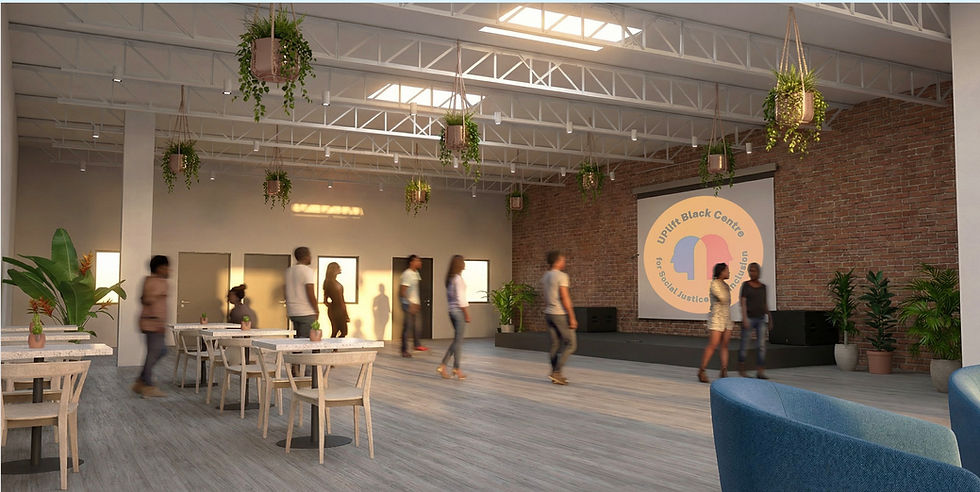
At the UPlift Black Centre for Social Justice and Inclusion in Barrie, we do the work that national strategies claim to value.
We run:
Business mentorship
Practical support for Black entrepreneurs who need guidance, networks, confidence, and access.
Artist and Creative Entrepreneurship Programs
Space for Black creatives to build their skills, share their work, and turn talent into opportunity.
Investment-readiness pathways
Support for people who are often locked out of capital, coaching, and business systems.
Youth safe spaces
Consistent programming where young people are seen, supported, and redirected before harm deepens.
Newcomer supports
Help for families navigating unfamiliar systems, services, expectations, and barriers.
Food security and mutual aid
Direct support for people facing real pressure right now.
This is justice work.
Yet non-profits are not eligible for the BEP loan fund. Short-term project grants do not cover the rent, utilities, insurance, administration, or permanent staff needed to Keep The Lights On.
That phrase is not symbolic for us. It is literal.
A regional Black hub cannot operate on applause. It cannot run on one-off grants that fund a workshop but not the room where the workshop happens. It cannot build trust with youth through a three-month pilot and then disappear. It cannot support people in crisis if staff are constantly fundraising just to keep the building open.
Keeping a regional Black hub open 365 days a year costs less than incarcerating two or three people for a year.
That is the comparison Ottawa needs to sit with.
If Canada can afford incarceration after harm occurs, it can afford community infrastructure that helps prevent harm in the first place.
What I will tell the Senate on November 30, 2026
When I appear before the Standing Senate Committee on Human Rights on Monday, November 30, 2026, I will not be asking for pity. I will be asking for policy that matches reality.
I will bring forward three demands.
Fund core operations for community justice work
Short-term project scraps are not enough.
Communities need multi-year core operational funding so organizations can plan, hire, retain staff, pay rent, cover utilities, evaluate their work, and stay open when people need them.
A project grant might fund a program. Core funding keeps the trusted space alive.
Canada’s Black Justice Strategy must include sustained operating support for Black-led organizations doing prevention, diversion, reintegration, legal navigation, economic support, and community care.
End regional gatekeeping in federal funding
Mid-sized regions like Barrie and Simcoe County must receive equitable justice and entrepreneurship funding.
Too often, resources flow through large urban centres and established gatekeepers. The same organizations are treated as the default doorways to Black communities, while regional Black-led groups are told to wait, partner, subcontract, or apply again next year.
That model fails communities outside major metropolitan cores.
If the federal government says Black justice is national, funding access must be national too. Regional Black hubs need direct pathways, fair criteria, and support that recognizes the realities of smaller and mid-sized communities.
Report the numbers clearly and publicly
Canadians deserve transparent public reporting that separates federal policing and prison budgets from community prevention dollars.
A Black Justice Strategy budget should not blur together:
Money for prisons
Money for policing
Money for federal data systems
Money for loans
Money for community-led prevention
Money for youth diversion
Money for reintegration
Money for legal navigation
These are not the same thing.
Clear reporting would allow Parliament, communities, journalists, and the public to see whether funding is reaching the people and places most affected by anti-Black racism in the justice system.
Without transparency, big announcements can hide small community investments.

This is bigger than one Senate appearance
I am grateful for the invitation to appear before the Senate committee. I take that responsibility seriously.
But this moment is bigger than one testimony, one organization, or one city.
This is about whether Canada’s Black Justice Strategy will reach the people who need it, or whether it will become another announcement that sounds historic while leaving regional communities to fight for survival.
It is about whether Black-led organizations are trusted with the resources to do the work they are already doing.
It is about whether public safety means more than punishment.
It is about whether Canada is willing to fund prevention with the same seriousness that it funds incarceration.
Here in Barrie and Simcoe County, we are not waiting for permission to serve. We are already doing the work. We are mentoring entrepreneurs. We are supporting artists. We are feeding families. We are helping newcomers. We are holding space for youth. We are responding to crisis. We are building belonging.
But commitment without stable funding becomes exhaustion.
And justice without regional equity becomes another form of exclusion.
How you can stand with UPlift Black now
If this message resonates with you, I am asking you to take three concrete steps.
Donate to UPlift Black’s KeepTheLightsOn campaign
Your support helps cover the core operating costs that grants too often ignore, including rent, utilities, staffing, and the everyday costs of keeping a regional Black hub open.
Tune in to the November 30 Senate Committee proceedings
Follow the Standing Senate Committee on Human Rights as it studies Canada’s Black Justice Strategy and hears from witnesses.
Share this post with your MP and MPP
Ask them where Black Justice Strategy dollars are going, how much is reaching community-led prevention, and why Barrie and Simcoe County have been shut out of the Black Entrepreneurship Program.
The choice before Canada is simple.
We can keep paying more than $349.6 million a year to incarcerate Black people federally, including more than $207 million tied to overrepresentation. Or we can invest seriously in the community-led supports that reduce harm, strengthen families, and create real opportunity.
UPlift Black is ready to keep doing the work.
Now Canada must decide whether it is ready to fund justice where justice actually happens.
Shelly-Ann Skinner, President and Founder
Data Sources
Department of Justice Canada
Canada’s Black Justice Strategy materials, public announcements, and related federal justice policy documents.
Correctional Service Canada
Federal custody population data, correctional expenditure information, and cost of custody figures.
Public Safety Canada
Federal corrections budget information and justice system reporting.
Office of the Correctional Investigator
Reporting on Black overrepresentation, risk classification, systemic discrimination, and correctional outcomes.
Federal Budgets 2024 and 2026
Budget allocations connected to Canada’s Black Justice Strategy, including the 2024 Fall Economic Statement and Budget 2026 commitments.
Innovation, Science and Economic Development Canada and FedDev Ontario
Black Entrepreneurship Program information, delivery structures, and regional funding access.


This is incredible work, Shelly! Will definitely tune in on November 30th (could you share a link for how to?) and share this with my MP and MPP.